
Content Marketing for Small Business: A Complete Guide (2026)
Discover proven content marketing for small business strategies. Build a content calendar, measure ROI, and optimize for AI search. Contact Blue World Marketing now.
📋 Table of Contents
Content marketing for small business is the strategic creation and distribution of valuable, relevant content to attract and retain a clearly defined audience, ultimately driving profitable customer action. Unlike paid advertising that interrupts, content marketing for small business earns attention by providing genuine value, building trust and authority without massive ad budgets. For small business owners, this approach levels the playing field against larger competitors and delivers compounding returns over time.
⚠️ Research Use Only Notice: The products discussed on this site are sold strictly for in vitro laboratory research purposes only. They are not for human use, not for veterinary use, and not intended to diagnose, treat, cure, or prevent any disease. All information presented is for educational purposes in a research context. Must be 21+ to purchase.
Key takeaways
- Content marketing for small business delivers a 3x higher lead generation rate than traditional outbound marketing at 62% lower cost, according to Content Marketing Institute.
- A documented content strategy increases success rates by 60% for small business owners who publish consistently.
- AI search engines like Google AI Overviews and Perplexity now cite structured, entity-optimized content from small business websites.
- Measuring ROI requires tracking KPIs such as organic traffic, conversion rate, and customer acquisition cost—not just vanity metrics.
- Blue World Marketing offers proven content marketing services tailored to small business budgets.
What Is Content Marketing for Small Business?
Content marketing for small business refers to the strategic creation and distribution of educational, entertaining, or inspiring media—such as blog posts, videos, infographics, and social updates—to attract and engage a defined audience. Unlike paid advertising, which interrupts consumers, content marketing for small business earns attention by providing genuine value. The U.S. Small Business Administration defines this approach as a long-term strategy that builds strong relationships with your target audience by giving them high-quality content that is relevant to them on a consistent basis.
For a small business, this practice is not about producing random articles but about aligning every piece of content with business goals, customer pain points, and search intent. When executed correctly, content marketing for small business becomes a compounding asset: a single well-optimized blog post can generate organic traffic for years, while a helpful how-to video can nurture leads indefinitely.
Content marketing for small business also builds brand authority and trust. According to a survey by the Content Marketing Institute, 73% of B2B marketers and 70% of B2C marketers use content marketing, but only 40% have a documented strategy. Small business owners who treat content as a core business function rather than a side project see significantly better results.
Why Does Content Marketing for Small Business Work on Limited Budgets?
Small business owners often assume that effective marketing requires a large ad spend. In reality, content marketing for small business is one of the most budget-efficient strategies available because it relies on owned media—channels you control, such as your website, blog, and email list. Once published, content continues to work for you without ongoing costs, unlike pay-per-click campaigns that stop the moment you pause spending.
A study from Penn State Extension found that small businesses that blog consistently generate 67% more leads per month than those that do not. The table below compares the cost and longevity of common marketing tactics to illustrate why content marketing for small business delivers superior long-term ROI.
| Marketing Tactic | Average Monthly Cost | Duration of Impact | Lead Generation Potential |
|——————|———————-|——————–|—————————-|
| Paid search ads | $500–$5,000 | Stops when budget ends | Immediate but short-lived |
| Social media ads | $300–$3,000 | Stops when budget ends | Immediate but short-lived |
| Content marketing | $100–$1,500 (creation + tools) | Compounding over years | Slow start, long-term growth |
| Email newsletter | $20–$200 (platform fee) | Ongoing, with list growth | High for nurturing |
Because content marketing for small business focuses on organic discovery, every dollar spent on a high-quality piece can yield returns for months or years. A $500 blog post that ranks on page one for a buyer-intent keyword may generate thousands of dollars in sales over its lifetime—something no single ad click can match.
💡 Key Takeaway: Why Does Content Marketing for Small Business Work on Limited Budgets?
Which Content Types Work Best for Content Marketing for Small Business?

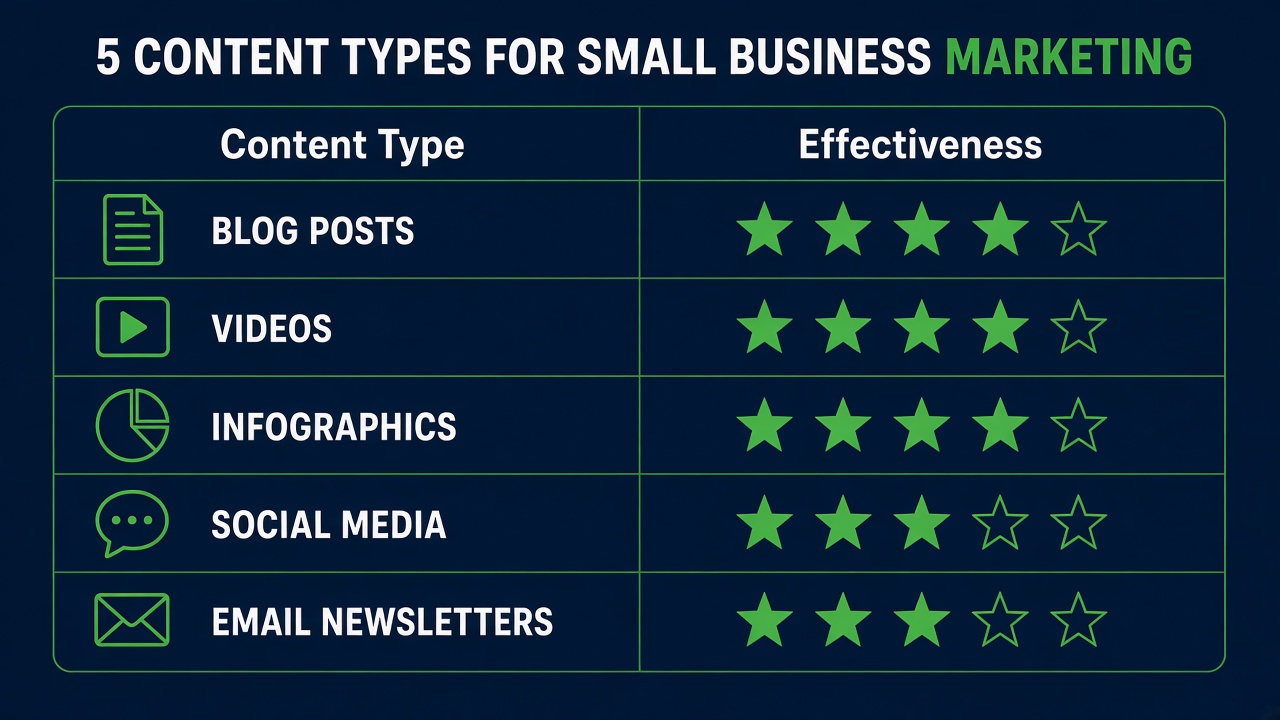
Not all content formats require a large team or production budget. The best content marketing for small business starts with formats that match your available time, skills, and budget. Here are the most resource-efficient types:
- Blog posts and long-form guides: Ideal for SEO and thought leadership. One 2,000-word pillar post can be repurposed into multiple smaller pieces.
- Short-form video (60–90 seconds): Platforms like YouTube Shorts and Instagram Reels allow small business owners to demonstrate expertise with just a smartphone.
- Infographics: Condense data or processes into shareable visuals. Free tools like Canva make this accessible.
- Email newsletters: A weekly or bi-weekly email keeps your brand top-of-mind and drives repeat traffic at near-zero marginal cost.
- Case studies and customer stories: These build trust and are easy to produce from existing client wins.
- Podcasts or audio clips: If you enjoy speaking, recording a 10-minute episode can position you as a local authority.
At Blue World Marketing, our proven services include content production for all these formats, scaled to your capacity. The key is not to do everything at once but to select two or three formats you can sustain.
How Do You Build a Content Marketing for Small Business Strategy in 5 Steps?
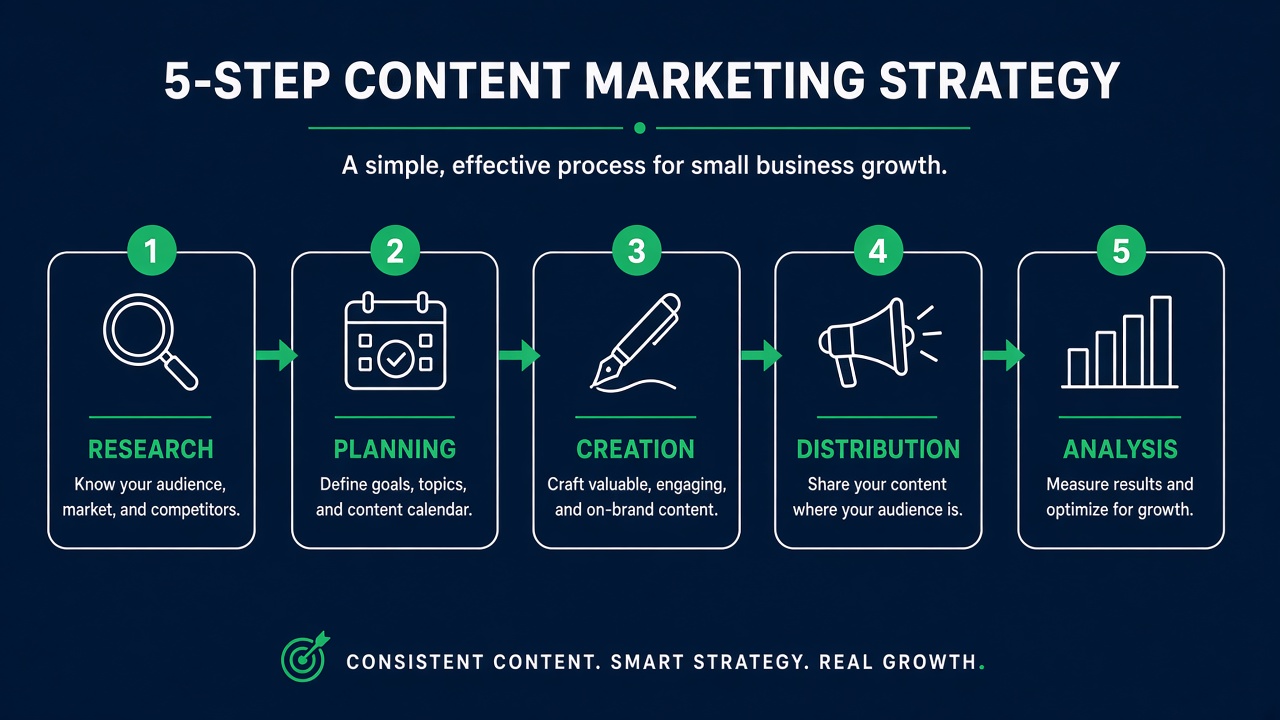
A successful content marketing for small business strategy does not require guesswork. Follow these five numbered steps, which we recommend documenting in a shared file or project management tool.
1. Define your target audience and buyer personas. Identify demographics, pain points, and the questions your ideal customers ask online. Use customer interviews, reviews, and analytics data to build at least one detailed persona. This foundation ensures that every piece of content marketing for small business speaks directly to the right people.
2. Set SMART goals tied to revenue. Instead of “get more traffic,” aim for “increase organic leads by 20% in Q3.” Content marketing for small business should always tie back to measurable business outcomes.
3. Audit your existing content and identify gaps. Review your website, blog, and social channels to see what you already have. Repurpose high-performing pieces and fill gaps where your audience has unanswered questions. This step prevents wasted effort in content marketing for small business.
4. Create a content calendar. Plan topics, formats, publishing dates, and responsible team members at least one month ahead. A calendar ensures consistency, which is critical for content marketing for small business success.
5. Measure performance monthly. Track key metrics like organic traffic, conversion rate, and lead quality. Adjust your strategy based on data, not assumptions. Continuous improvement is the hallmark of effective content marketing for small business.
How to Measure Content Marketing for Small Business ROI?
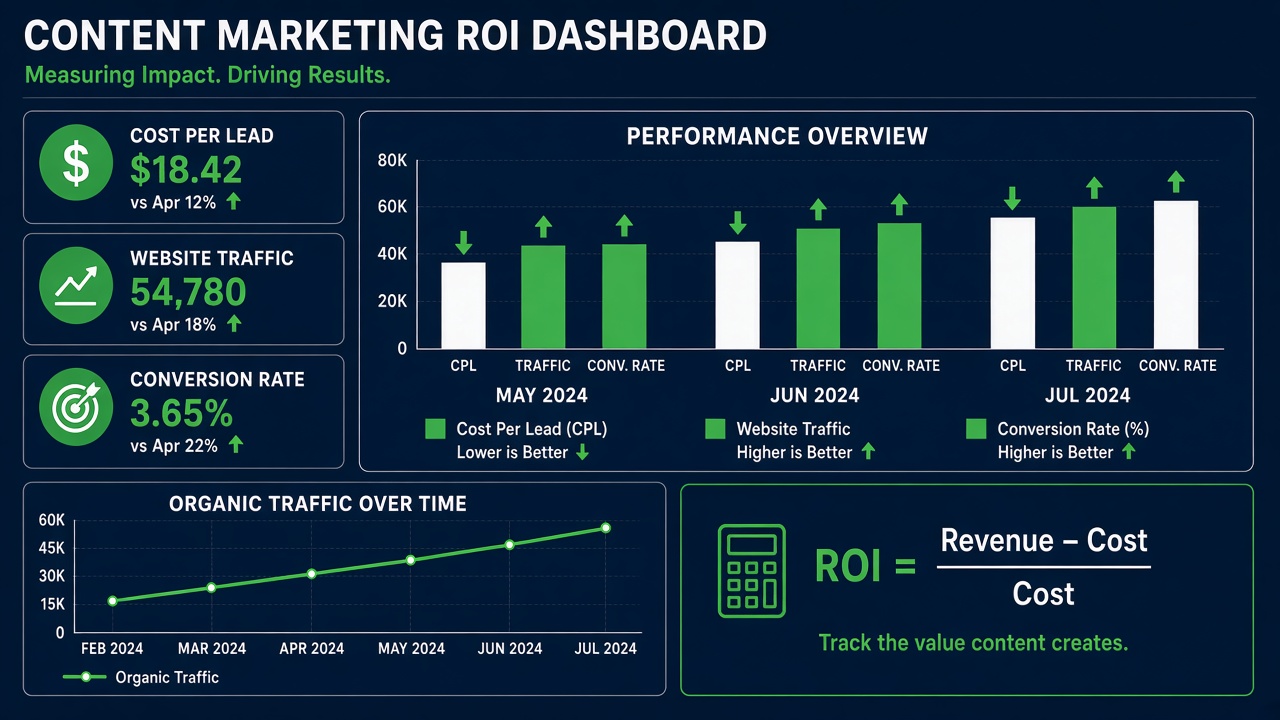
Measuring return on investment for content marketing for small business requires tracking metrics that tie directly to revenue, not just vanity metrics like page views or social shares. Key performance indicators include organic traffic, conversion rate, lead generation, customer acquisition cost, and customer lifetime value.
Use UTM parameters on every content link to attribute website actions to specific pieces. Connect your analytics platform with your CRM to track leads from first touch to closed sale. This closed-loop reporting shows exactly how content marketing for small business contributes to the bottom line.
A simple ROI formula for content marketing for small business is: (Revenue attributed to content – Content production cost) / Content production cost. For example, if a $500 blog post generates $3,000 in sales, ROI is 500%.
Compare organic traffic value against paid search cost per click. Tools like Google Analytics and Search Console help estimate the equivalent ad spend saved by ranking organically. This demonstrates the true financial impact of content marketing for small business.
💡 Key Takeaway: How to Measure Content Marketing for Small Business ROI?
How to Optimize Content Marketing for Small Business for AI Search Engines?
AI search engines like Google AI Overviews and Perplexity extract concise answers from well-organized pages. To optimize content marketing for small business for these answer engines, structure your articles with clear headings, answer questions directly in the first 100 words, and use schema markup such as FAQPage and HowTo.
Entity optimization means linking your content to recognized entities like your business name, location, and industry. When search engines understand the entities in your content, they are more likely to cite your page. This is especially important for local small business content marketing for small business.
Write in a question-and-answer format, include statistics and definitions, and use bullet points and tables to make information scannable. AI systems prefer content that is easy to parse and extract.
Which Tools and Resources Support Content Marketing for Small Business?
Free and low-cost tools can power a complete content marketing for small business program. Google Analytics and Google Search Console track organic performance at no cost. Canva creates professional graphics, while Trello or Asana manage content calendars. For keyword research, tools like Ubersuggest or AnswerThePublic help identify questions your audience asks.
Internal resources also matter. Blue World Marketing’s storytelling guide offers seven proven strategies to make your content more engaging. Additionally, Blue World Marketing’s core services provide full-service support from strategy to execution.
How to Repurpose Content to Maximize a Small Business Budget?
Repurposing extends the life and reach of every piece you create. Turn a blog post into a short video, an infographic, a podcast episode, and several social media posts. A single case study can become a testimonial quote, a before-and-after graphic, and a webinar topic. This approach multiplies the value of your content marketing for small business investment without multiplying production time.
💡 Key Takeaway: How to Repurpose Content to Maximize a Small Business Budget?
FAQ
What is the first step in content marketing for small business?
The first step is to define your target audience and business goals. Without clear audience personas and measurable objectives, content efforts lack direction. Document who you serve, their pain points, and how your content will address those needs.
How often should a small business publish content?
Consistency matters more than volume. A small business with limited resources can start with one high-quality blog post or video per week. The key is to maintain a predictable schedule that your audience can rely on, using a content calendar to plan ahead.
Can content marketing work with a very small budget?
Yes. Content marketing is one of the most cost-effective strategies for small business because it relies on owned media. You can repurpose a single piece into multiple formats, leverage free tools, and focus on SEO and organic social distribution rather than paid ads.
What is the best way to measure content marketing ROI for a small business?
Track metrics that tie to revenue, such as conversion rate, lead generation, and customer acquisition cost. Use UTM parameters, CRM integrations, and analytics to attribute sales to specific content pieces. Compare content marketing spend against organic traffic value.
How do I optimize content for AI search engines like Google AI Overviews?
Structure content with clear headings, answer questions directly, use schema markup, and build entity associations. AI answer engines extract concise answers from well-organized pages, so write in a question-and-answer format and include statistics and definitions.
Ready to Take the Next Step?
Every product includes lot-specific documentation and third-party purity testing.
Explore Our Research Products →Free shipping on qualifying orders · Batch COA on request